In Leipzig it was not allowed to paraphrase the words of the Gospel in a Passion presentation on Good Friday. In 1725 Christian Friedrich Henrici, a Leipzig poet who used Picander as his pen name, had published Erbauliche Gedanken auf den Grünen Donnerstag und Charfreytag ("Edifying Thoughts on Maundy Thursday and Good Friday"), containing free verse suitable for a Passion presentation in addition to the Gospel text. Bach seems to have stimulated the poet to write more of such verse in order to come to a full-fledged libretto for a Passion presentation combined with the Passion text chapters 26 and 27 in the Gospel of St Matthew.
Bach revised the Passion by 1736, for a performance on Good Friday 30 March 1736. This is the version that is generally known as the St Matthew Passion, BWV 244, which we will perform in April 2027. In this version both choirs have SATB soloists and chorus, and a string section and continuo consisting of at least violins I and II, viola, gamba and organ. The woodwinds are two flutes, oboes and oboes d'amore for each choir, and in addition for choir I two oboes da caccia.
Noted Bach scholar Christoph Wolff says the double choir called for in the St. Matthew Passion is not introduced for its own sake, but reflects the principle of the libretto with two allegorical partners—"the daughters of Zion" and "the Faithful"—contraposed in dialogue with one another. There are three fundamentally different textual layers of the St. Matthew Passion, madrigalian poetry, biblical text, and hymns, none of which stand in abrupt juxtaposition.
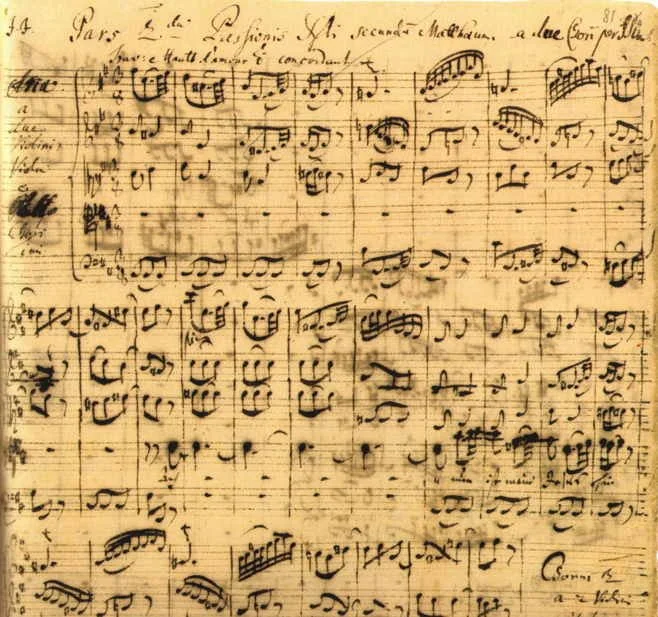
A note on the physical condition of the manuscript
The manuscript, more than any other autograph of Bach, has undergone significant physical damage. Even while still in the possession of the composer, perhaps in the later 1740s, some mishap (fire?) occurred to the first 13 leaves forcing Bach to cut off the outer margins, glue on replacement strips, and recopy the missing musical material. Then in the early 20th century library staff observed serious ink corrosion eating through the paper. The first restoration attempts included overlaying a thin piece of silk chiffon attached with rice starch to bond the paper. In the 1990s separating leaves were inserted between leaves to prevent bleed through. Subsequent investigation determined that the silk chiffon application actually hastened the ink erosion. Conservators now used a different procedure, actually "splitting" the original leaves into front and back sides and then inserting a paper with an alkaline buffer. In this process weak spots in the leaves were reinforced with fine cellulose fibers and adhesive gelatine used to reunite front and back sides of the leaves encapsulating the damaging ink. The exterior silk chiffon was removed. How much the manuscript has suffered in the last 90 years can be seen by the Biblical texts, originally in red ink—and captured in the Insel facsimile—now faded, in part due to the removal of the silk chiffon. (adapted from the commentaries of Christoph Wolff and Martina Rebmann)
Special thanks to OMI - Old Manuscripts & Incunabula, New York
St. Matthew Passion
"It is certainly no error of judgement to consider Johann Sebastian Bach's St. Matthew Passion as the first significant monumental work of music history still shining in a splendour undiminished by the passage of time. ... the manuscript original score... in its external features alone an especially precious jewel, is unlike any other Bach autograph." — Christoph Wolff
The St. Matthew Passion is a sacred oratorio written by Johann Sebastian Bach in 1727.
It sets the 26th and 27th chapters of the Gospel of Matthew to music, with interspersed chorales and arias. It is widely regarded as one of the masterpieces of Baroque sacred music.
Little is known with certainty about the creation process of the St Matthew Passion. The available information derives from extant early manuscripts, contemporary publications of the libretto, and circumstantial data, for instance in documents archived by the Town Council of Leipzig.
The St Matthew Passion was probably first performed on 11 April (Good Friday) 1727 in the St. Thomas Church, and again on 15 April 1729, 30 March 1736, and 23 March 1742. Bach then revised it again between 1743 and 1746.